

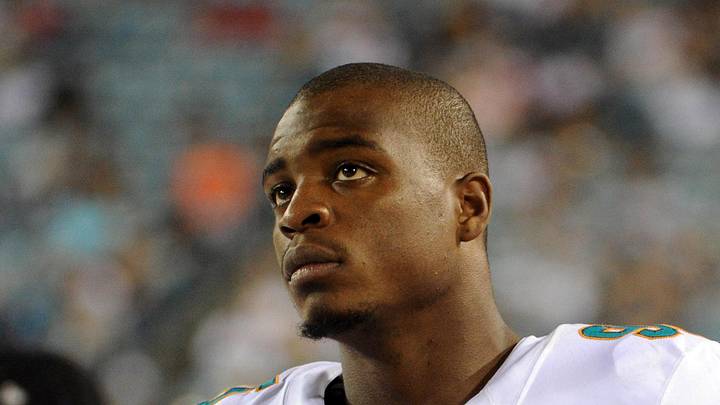
Playing only six years in the NFL after being the No. 3 overall pick of your draft class is a heavy weight to carry on one's shoulders. Alas, it's the position Dion Jordan finds himself in, 13 years after the Miami Dolphins traded up in the first round to bring him to South Beach, bypassing potential Hall of Famer Lane Johnson in the process. It appears as if Jordan has found his calling later in life, and it's in the least likely of places.
Dion Jordan is the proud head coach — a post he inherited from former Dolphins defensive tackle Randy Starks — for the Eureka College Red Devils, a tiny Division III institution with a student population of less than 600 total, nestled in Eureka, Illinois. The college's claim to fame is being the alma mater of former U.S. President Ronald Reagan, as well as being only the third American institution to admit men and women on an equal basis.
It is from this special place that Dion Jordan opened up to The Athletic's Dan Pompei about his story. For Dolphins fans who may not quite remember, Jordan's issues came in a variety of forms, including injuries, failed drug tests, and clashes with coaches. His underwhelming tenure ended with as many sacks (3.0) as his original draft slotting. That was a far cry from "the next Jason Taylor" that he was billed as coming out of Oregon.
Dion Jordan didn't pan out, that much is obvious — but the Miami Dolphins shoulder some of the blame
In this unexpected feature, however, he makes it clear that the Dolphins weren't exactly blameless in his failures. Jordan represents accountability in droves, though his recollection of his time in Miami reflects the dysfunction fans have unfortunately become used to.
Upon descending on the Dolphins' Davie campus, Jordan was still recovering from offseason shoulder surgery. The regime in charge had also asked him to put on weight, to help him adjust from the outside linebacker position he played with the Ducks to the more traditional defensive end spot he'd play in Miami. Naturally, he's healing, moving slower — and the Dolphins, a little too eager to see their new toy, rush him onto the field anyway. Ah, a trademark Miami master class in bungling a player's career.
“My competition knows what’s going on and they are taking advantage of it,” Jordan says. “The people in the building don’t give a [crap]. They don’t care if your shoulder’s hurt. ‘Figure it out how to rush. We’re paying you to play.’”
A difficult rookie season took Jordan down a path of self-destruction. Armed with millions of dollars and the lack of supervision the offseason affords, you can guess what happened next. He failed his first drug test that offseason. Then his second. Finally, a third. The carnage? A six-game suspension. Not exactly the best way to kick off your second year in the league. That was a breeze compared to what befell him before Year 3.
In large part due to his missteps in 2014, Jordan found himself on razor-thin ice. And he cracked it. He failed his fourth drug test ahead of the 2015 season, this one leading to a year-long suspension. The Dolphins, for their part, stood by their investment. It's evident, however, that enough support wasn't available for a player who clearly needed it.
The 2016 season proved the end of a solemn saga in Dolphins history. Jordan had seemingly gotten his head on straight and was ready for his return. The universe had other plans, and he tore his meniscus. The recovery proved difficult, and after giving it a go in training camp, he wound up having to shut it down for the season, a development that he reacted to poorly. Rather than head to Pittsburgh for the team's first playoff tilt since 2008, Jordan packed his bags and went home.
“I had been there for 20 weeks,” Jordan said. “I checked out, packed all my [stuff] and went back to California. I had dug myself a hole and wanted to get out, but I knew it wasn’t going to be there.”
Just like that, after four years on the roster and only the initial two on the field, Dion Jordan's career in Miami was finished. He went on to have a short-lived revival with the Seattle Seahawks before he found himself back in the all-too-familiar injury/failed drug test loop. In any case, it's good to see that he's found his calling. In mentoring young football players, Jordan has life experience that can serve a far greater purpose than it did on the field.
In telling his story, however, fans have been served a harrowing reminder of the ineptitude that has permeated team walls for far too long. Armed with a new general manager in Jon-Eric Sullivan, the new regime appears ready to reinvent Miami Dolphins football. Fans can only hope they're able to avoid the next Dion Jordan situation by supporting him before it's too late.
 Add us as a preferred source on Google