

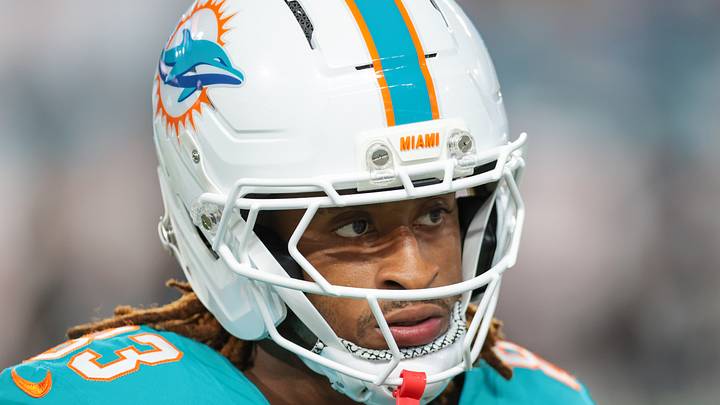
Malik Willis has struggled mightily through the first month of the season for the Miami Dolphins. With the Cincinnati Bengals on deck in Week 5, Willis currently sits with a 56.3 percent completion rate (28th out of 29 qualified passers), 712 yards (25th), and just one touchdown pass (tied for 36th). He also has four turnovers (2 interceptions and 2 fumbles), which ties for 10th most in the league.
While it's more than fair to point out Willis' shortcomings, he's not the only one failing to carry his weight on offense. From the moment Miami needlessly chose to trade Jaylen Waddle to the Denver Broncos, it was clear that a quarterback evaluation would be difficult with such a young group of wide receivers. The season has borne that out.
One particularly concerning trend in Willis' game has been his penchant for holding onto the ball. Of course, holding onto the ball is preferable to throwing an interception to a blanketed wide receiver. Unfortunately, covered receivers have been a familiar sight all season long. The advanced analytics paint a troubling picture and decry the Dolphins' desperate need for Caleb Douglas' return from injury.
Miami Dolphins wide receivers are having a very hard time getting open, according to Next Gen Stats
NFL Next Gen Stats has a valuable tracking tool to help understand what it is that makes some receivers successful, and others... not so much. The name of the game is separation — in other words, how open someone gets. NGS defines the stat as: "The distance (in yards) measured between a WR/TE and the nearest defender at the time of catch or incompletion."
When filtered to remove tight ends, that leaves 97 receivers with enough receptions to qualify. Malik Washington has played the most snaps for Miami this season, and his average of 3.5 yards of separation ranks 17th in the league. That helps contextualize why he's been the Dolphins' most productive receiver.
On the flip side, second-round rookie Chris Bell ranks 90th, with an average separation of 1.9 yards — he's played the second-most snaps of any receiver. Then Kevin Coleman Jr., the Dolphins' third-leading snap-getter, ranks near the bottom at 96th. His average separation of 1.6 yards is only ahead of Marvin Harrison Jr. of the Arizona Cardinals.
While it hardly absolves Malik Willis of blame, it perhaps explains why he's holding onto the ball so long. If all he sees downfield are receivers draped by defensive backs, it's the responsible thing for him to hold it longer to see if they can shake loose. At some point, though, he's going to need to put his trust in his receivers and let it fly, even if he doesn't find them when they're wide open.
There is reason for hope, however. Caleb Douglas played 51 snaps in Week 1 against the Las Vegas Raiders before playing precisely 51 against the San Francisco 49ers in Week 2. He suffered an ankle injury late that knocked him out of that game's conclusion and kept him out of the last two games. In any case, his average separation of 4.6 yards ranks second in the league among qualified receivers.
After putting up 94 yards in Week 1, it's safe to say that Douglas has already demonstrated some ability to get open. His absence has proven to be a crushing blow to Miami's receiving unit. The sooner he gets back, the better.
It's also worth noting that no one should be counting out Bell or Coleman Jr. at this point, either. These kinds of things are to be expected with rookie receivers as they learn the ropes. In an ideal situation, you might rely on a rookie to be your third or fourth receiver. The Dolphins' idea of rolling with three rookies among their top four was always ambitious.
When a team is 0–4, it doesn't exactly take a magnifying glass to find issues. Miami is hurting tremendously on offense right now, and their rookie receivers are a big reason why. In Week 5, the Cincinnati secondary provides the next opportunity for the unit to take flight after four straight weeks of crash landings. There's nowhere to go but up.
 Add us as a preferred source on Google