

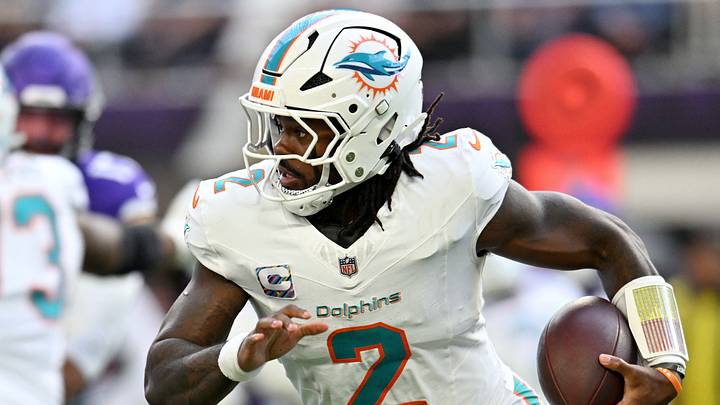
The Miami Dolphins are 0-4, and despite getting better from week to week, there is still a lot of work to be done. Miami is the youngest team in the NFL this year, so there are no surprises with the record. The surprise, honestly, is with the guy who was handpicked to lead the offense.
Malik Willis isn't bad by any means, but he isn't good either. He's somewhere in between. It's easy to look at the youth of the receiver room, the absence of Caleb Douglas, and spotty offensive line play to make excuses for the quarterback, but you can't.
Dolphins fans knew this was going to be a tough year. The trade of Jaylen Waddle was smart, needed, and there should be no regrets. He would have helped Willis a little more, but honestly, his presence may have only made Willis look as though he was struggling more.
Malik Willis has to lead the Miami Dolphins with smarter decisions than he is making
There are two sides to every fence. There are those who look at the statistics and see Willis behind the wall because of the youth. There are stats to support that. Our own Dante Walker wrote a solid piece describing the problems the receivers are having with separation.
Those issues can't be summarily tossed aside. If Willis looks downfield and sees a tight throwing window, he isn't going to take an unnecessary shot. That leads to holding onto the ball far too long. But there is a bigger problem that those stats don't show.
While the NFL is tracking separation yards, it does not track players who are not targeted, and this is where Willis is struggling. His vision of the field is becoming a problem. His decision-making with the football is a problem, and his inability to make a quick read is a problem. Right now, Willis is playing far too safe. It's time he starts taking risks.
There have been several instances of receivers being open. Whether it's hot routes or coverage breakdowns, many play reviews show a tight end or a WR moving into space and Willis not seeing them. When an offense struggles, it's important to identify the open lanes. Willis isn't doing that consistently. Instead, he is falling into a trend that Tua Tagovailoa was all too familiar with. He hesitates.
Willis has missed open receivers breaking from their routes inside. Those are quick throws that must be on time before the covering defender passes the receiver to someone else. These are sentinel chain-moving plays. In four games, Willis has completed 56.3% of these passes. That's 58 completions on 103 attempts. That isn't all on the receivers. It's decision-making. And inside the red zone. It gets worse. Miami has just one passing TD.
Either the QB doesn't make the read quickly enough, or he doesn't have confidence in the receiver, but he needs to start putting the ball in the right hands rather than trying to force the ball into coverage. It's much easier to see the guy running down the field open than it is to react quickly to get the receiver breaking in or out on a route before coverage recovers.
Willis is trying to do too much on his own, but even that fails at times. Against the Vikings, Willis completed just 9 of 17 passes for a stunningly low 85 yards. Sure, he was under pressure, but his throws were inconsistent and bad. The timing of his release to the window of immediate separation was bad. It doesn't matter if a WR is getting open three seconds into a play if he is open two seconds into it. In the NFL, a second is a minute.
Across four games, there isn't enough to say Willis would be any better with Waddle, or even Caleb Douglas, on the field. He is inconsistent with his decision-making. His ball security is a problem. His accuracy is questionable.
If Waddle had stayed, it would potentially have created a different problem for Willis. Tunnel vision. It would be much easier to force throws to Waddle and thus misread other opportunities. Given Miami's inexperience at the position, defenses would have locked in on Waddle without the threat of another option. Would Waddle have made Willis' job a little easier? At times, maybe.
In Week 4, the Dolphins had the ball on the Vikings' 8-yard line. On 3rd down, Willis' lack of a quick decision allowed the Vikings to cover the inside slant. Willis broke outside to his right. He wasn't likely to get into the end zone, but instead of running with the ball and perhaps making the first down, he forced the ball to Kevin Coleman Jr. at the front pylon. It was a low-end completion, and not a good decision.
There are plays that Willis is leaving on the field. What is troubling is that, after four weeks, he isn't improving, but he isn't getting worse either. He is stuck between average and mediocre.
To be fair, his young receivers don't often help his case. The offensive line isn't giving him the time he seems to need, and he clearly needs more time to process the field, but if you miss the initial break, time doesn't matter. Willis will get better as he builds trust with his receivers to make the tougher throws. He may not be showing the quality of a "franchise" level QB, but that's not why he is in Miami.
Four weeks is too early to judge any player, let alone a quarterback who had six starts for two different teams in four years when he arrived in Miami. Just like those receivers, there is a learning curve. Willis has to be better with the ball, and he has to get rid of it on time, but he also needs to stop zeroing in on specific WRs. He has the ability to look over the field quickly, so why is he not finding the open receiver? Confidence in the player or himself?
The Dolphins are not good enough offensively to play a long game. Their bread and butter is the short, quick pass that exploits the off-coverage defenders are giving the WRs at the line. That's the money, and right now, Willis is just counting the change.
 Add us as a preferred source on Google