

It's been a long, long time since the Miami Dolphins had a hands-down, bona fide franchise quarterback. We're talking Dan Marino, who retired following the 1999 season as the last concrete example. In the interim, Miami has either employed quarterbacks whom no one believed in as a franchise guy — Gus Frerotte, Joey Harrington, and Cleo Lemon, to name a few — or they've been plagued by the worst curse in pro sports: signal-callers who teeter between good enough and mediocre.
I take no pleasure in driving fans down memory lane, pointing out the frightening number of quarterbacks who lasted several years because of their ability to prove competent, if not game-changing. Tua Tagovailoa, Ryan Tannehill, Chad Henne, and Jay Fiedler all spent years wasting away varying levels of talent alongside them as the team wandered the quarterback-less desert, falling for each mirage along the way.
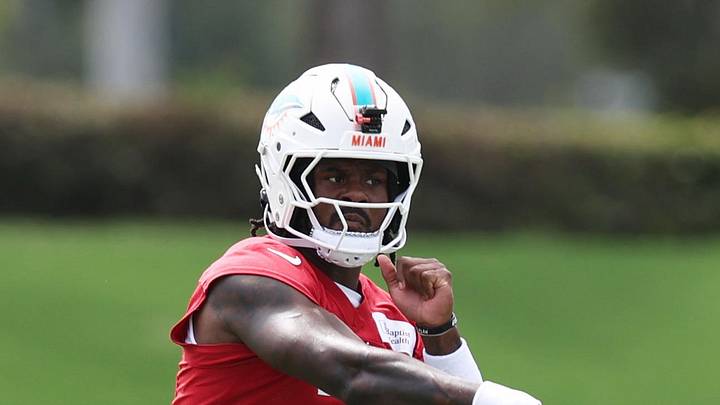
With the Dolphins' latest dice-roll at the position, it's safe to say fans would like to see Malik Willis perform like an undisputed franchise quarterback first, and if not that, they want him to stink up the joint. The last thing anyone wants to see is the franchise limp to six wins with quarterback play that resembles the status quo in Miami for the last quarter century and have zero chance to draft a top-tier QB.
The Miami Dolphins' immediate future hinges on Malik Willis, one way or the other
It's funny when fans or media who don't follow Miami closely describe them as a tanking team. In fact, the chasm among Dolphins fans lies precisely in their decision to sign Willis in the first place. If the team is tanking, let them tank. The team could've rolled with Quinn Ewers on his cheap seventh-round rookie contract. Instead, when they inked Malik Willis to a three-year, $67.5 million contract, they did precisely what they did the last time they tried to tank in 2019.
In 2019, it was Ryan Fitzpatrick. Say what you will about Fitzmagic, but he played his absolute tail off in Miami and created memories fans will never forget. This means he also played too well for the team to draft Joe Burrow — the consensus top quarterback of the 2020 draft class. There is one key difference between Fitzpatrick and Willis, however, that should give fans hope.
Fitzpatrick was 36 years old when he signed with Miami. There was no tangible reason whatsoever to believe he'd be a long-term solution. He was the stereotypical bridge quarterback — a player respectable enough for a team to roll with for a year while they restart. Malik Willis is a whole decade younger than Fitzpatrick was, having just turned 27 in May. That alone changes the equation, but there's one thing that will prevent this whole saga from becoming a debacle: discipline.
Malik Willis deserves some benefit of the doubt, but the Dolphins cannot treat him like a rookie quarterback. Willis is not entering his first year in the league — he is not a ballyhooed top-10 pick who needs time to marinate. He is a veteran player who has spent plenty of time in NFL locker rooms, even if not on the field. His performance must be evaluated accordingly.
What's more, despite winning and losing being the ultimate barometer of success, you simply know a franchise quarterback when you see one. As the Kansas City Chiefs limped to a 6–8 record with Patrick Mahomes in 2025, no one on planet Earth — or any other planet — wondered if the team should consider a change at QB. In fact, the Chiefs broke the bank for Mahomes a few weeks ago after his worst season, which also included a season-ending injury. That's what you do for a franchise quarterback.
It doesn't have to be that extreme either. Take a look at the rookie seasons by guys like Burrow, Matthew Stafford, and Baker Mayfield, for example. Despite losing a ton, few had any doubts about those players' abilities as great QBs. They kept their teams in games they had no business being in, stealing a few wins along the way.
Where things get dicey is on the other side of the coin. Cam Ward, Trevor Lawrence, and Bryce Young were all No. 1 overall picks. They all deserved (and deserve, in Ward's case) time to marinate. The issue for Willis is that he has neither their youth nor their pedigree. If Willis performs in 2026 like rookie Ward, Lawrence, or Young — the Dolphins flat-out cannot afford him the same leash.
That will be the single defining decision of this new regime. If Willis cannot prove to be a winning quarterback in 17 games in 2026, the Dolphins must find a way to bring a top-flight rookie quarterback to South Florida come hell or high water. It would be an abject failure to forge on with Willis as the unquestioned starter if he doesn't show considerable ability in South Florida.
The pressure is obviously on. If the small sample size from the last few seasons for Willis is any indication, he just might be built for it. If not, though, the Dolphins simply cannot treat him like a 21-year-old first-round pick. Willis is staring down the barrel of a fantastic opportunity. Here's to hoping he represents the change Dolphins fans want to see and exceeds all expectations. We'll all be watching.
 Add us as a preferred source on Google