

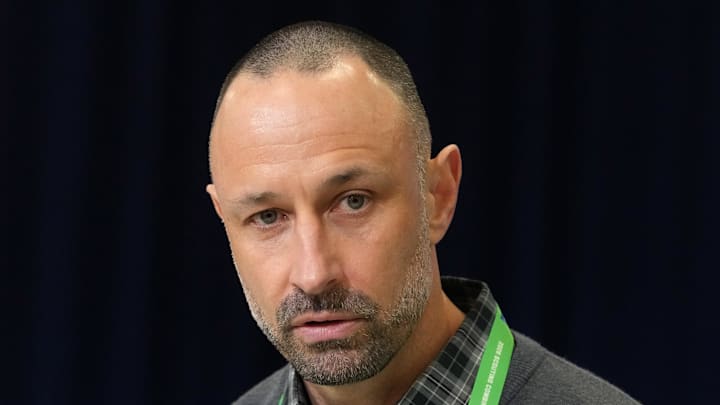
It looked like Jon-Eric Sullivan was about to be on every Miami Dolphins fan's Christmas card just prior to the team's first selection in the 2026 NFL Draft. The first 10 picks went swimmingly for Miami. So much so, that when it was their time to pick, they had Ohio State safety Caleb Downs and Miami Hurricanes pass rusher Rueben Bain Jr. available for the taking.
Smartly, Sullivan made a deal while on the clock with the Dallas Cowboys to move back one spot and pick up two fifth-rounders in the process. To no surprise, Dallas took Downs, leaving the Dolphins to take Bain if they wanted him.
But they didn't, and the Dolphins instead went with Alabama offensive tackle Kadyn Proctor, which soon left fans divided on the decision. Sullivan then made another move with Miami's second first-round pick; this time, moving up a few spots to take San Diego State cornerback Chris Johnson.
Johnson has been a popular pick for Miami leading up to the draft, so the selection made sense. But was the move up necessary? Hindsight says no, leading to a rather underwhelming night for the Dolphins' new GM.
Jon-Eric Sullivan trades both picks on Night 1 of the draft, but still underwhelms in first draft as Miami Dolphins GM
To be clear, Sullivan's picks on Night 1 were "fine." And by fine, meaning in the true definition, not when your significant other says they're fine, but really, you're in the doghouse indefinitely, and you probably don't even know why.
Proctor may end up being the long-term prospect on the left side that the Dolphins need, especially with Austin Jackson all but set to be gone after this year. If Proctor can be Miami's left tackle or even a Pro Bowl-level guard for years to come, then pick 12 will look like a steal years down the line.
However, Proctor comes with risks. And it's the type of risks fans had hoped to be rid of when Chris Grier was finally shown the door. Proctor has openly admitted that he's had weight issues, even going as far as to say that he doesn't believe he's a three-down lineman if he doesn't keep his weight under control.
There were concerns about Bain's arm length, and apparently, it was a big enough concern that Miami decided to pass. Concerns with Proctor, though, can essentially be fixed, and that was possibly the difference-maker for Sullivan to pull the trigger.
There were concerns with Patrick Paul when the Dolphins initially drafted him in 2024, but he's progressed admirably in his time in South Florida. Miami is hoping for the same outcome with Proctor now. If so, the Dolphins' OT positions will be locked up for the long haul -- which is not something fans have been able to say for the better part of two decades.
The Johnson pick was better received by the fan base, as he had been a popular pick for Miami. To ensure they got him, though, the Dolphins moved up three spots from No. 30 to 27 in a deal with the San Francisco 49ers. Miami did not give up any additional draft capital, but they did swap pick 90 for 138 to complete the deal. A move back 48 spots in the middle rounds to move up three here seems questionable on the surface.
The important thing is that Sullivan got his guy. And despite playing at a smaller school like San Diego State, Johnson has the tools to be a sensational corner for the Dolphins. But I can't help but feel he still would've been there had they stayed put.
It's important to note that no other CB was drafted after Johnson at 27. In fact, besides Mansoor Delane at No. 6 overall to Kansas City, surprisingly, no other cornerbacks were taken in Round 1. That only further extends my belief that he still would've been there.
To play devil's advocate, though, the Dolphins did initially move in front of the Buffalo Bills when the trade was made. Buffalo needs a corner, too, and Johnson could have been on their radar. The Bills moved back, though, following Johnson's selection, and then again to completely be out of Round 1, so we're still unsure what direction they're seeking.
Furthermore, given the prospects that were still on the board (and remain), I think it's best if Miami had let the draft come to them in that situation and allowed Johnson to fall to them at 30. Even if another team had taken him, guys like Omar Cooper Jr. and Keldric Faulk could have been had, and would have been terrific picks in that slot.
Other secondary players expected to go in Round 1, like Toledo's Emmanuel McNeil-Warren and Tennessee cornerbacks Jermod McCoy and Colton Hood, remain available ahead of Night 2. Avieon Terrell is also still available, as well as edge rushers T.J. Parker, Cashius Howell, and Zion Young. Any one of those guys would have been a great selection at pick 30 for Miami.
Nevertheless, the Johnson pick was a good one by Sullivan. In hindsight, so was the Proctor selection, even if fans aren't ready to admit it. Miami needed to add OL help and get better in the secondary, and they accomplished both of those tasks on Night 1.
The good news is that there are several top prospects remaining on the board. I can see the Dolphins taking any one of the aforementioned players if they continue to fall. If they're successful, and I think there's a good chance they will be, this draft will start to round out for the Dolphins, and the fan base will come around to the full picture and be excited about what Sullivan is building.
 Add us as a preferred source on Google